
Zoom on Charles and Ray Eames
The 1950s were a period of renewal and optimism. The austerity of the postwar era gradually faded in the face of unprecedented consumerism. In the decorative arts, the distinctive national traits so prevalent before World War II were virtually erased by a "constructive pacifism" and the universal pursuit of quality. New materials, such as laminated plastics, fiberglass, and latex foam, shaped the aesthetics of the 1950s. Designers drew inspiration from sources as diverse as molecular chemistry, nuclear physics, science fiction, African art, and contemporary abstract sculpture. The angular, sharp forms of the early 1950s gradually gave way to more organic and biomorphic silhouettes.
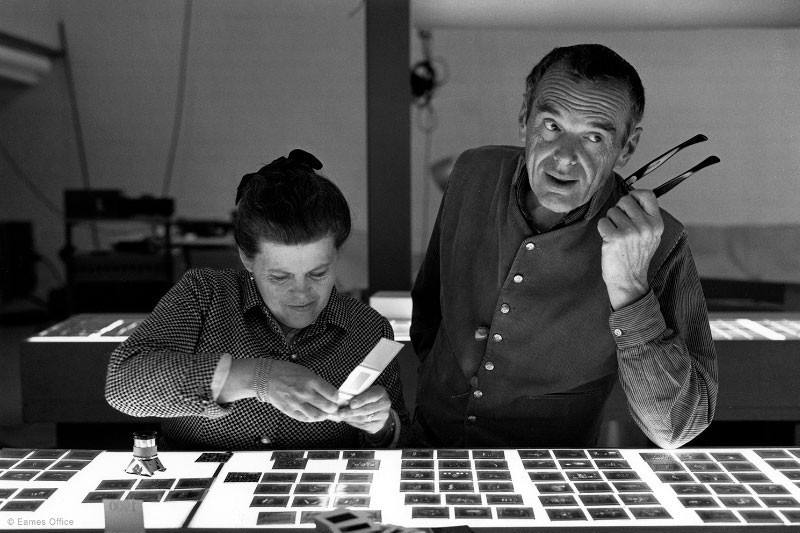
Charles and Ray Eames were a pioneering design duo, design legends whose success was dazzling and enduring.
In 1949, they designed the Herman Miller showroom in West Hollywood. This exhibition space incorporated elements of the Eames House, with its steel structure and modular compartments. The following year, Herman Miller began selling the plastic chairs presented at the MoMA exhibition. The Eameses offered these chairs in various versions, in different colors, with casters, rocking, or swiveling. The goal was to provide customers with a chair that met their individual needs.
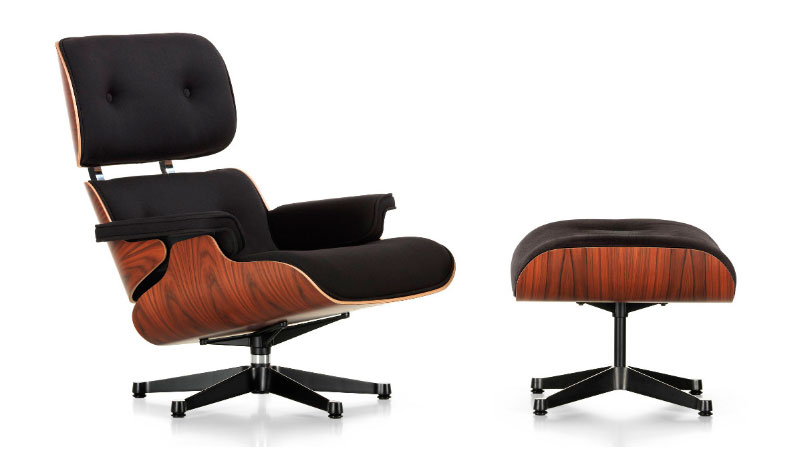
In 1956, Charles and Ray Eames created the Eames Lounge Chair, which revolutionized the market for relaxation seating and became a huge success. In 1957, the Swiss company Vitra signed a licensing agreement with Herman Miller to manufacture and distribute Eames furniture in Europe and the Middle East.
The Creative and Happy Alchemy
It was the story (and the subject of much jokes) of an architect who didn't build and a painter who didn't paint, yet who knew how to combine their talents, becoming indispensable to the production of objects bearing both their names.
The creation of the Eames Office allowed them to realize their aspirations: to mass-produce quality furniture at an affordable price. From their first creations in molded plywood, they launched, in collaboration with Zenith Plastics and Herman Miller, what would become their greatest success: the "Eames chair," a molded plastic chair with a unique shell, which became an icon of 20th-century design.
Charles Eames understood that Ray was his alter ego in his creations and always acknowledged it. Here's how Charles described their relationship: "Anything I can do, Ray can do better." But Ray needed time for him to fully realize his talent.
IBM and the Eames Office
For over twenty years, IBM commissioned Charles and Ray Eames to create promotional films, presentations, and educational materials.
Their approach was to simplify complex ideas. At their first exhibition, "A World of Numbers... and Beyond," presented at the California Museum of Science and Industry in 1961, "Mathematica" was an interactive space designed to introduce the public to mathematical theories in a playful, accessible, and immersive way.
A New Institute in California
Following the Eames Office and the Eames Foundation, the Eames Institute of Infinite Curiosity opened its doors in 2022 in Petaluma, California. Curator Llisa Demetrios created this non-profit organization as a tribute to her grandparents, who were designers, artists, architects, and filmmakers.
The collection aims to inspire all those who wish to use design as a tool to build a better future.